Back to the learning disabilities landing page
Care (Education) and Treatment Reviews (C(E)TRs) are part of NHS England’s commitment to transforming services for people of all ages with a learning disability and autistic people. C(E)TRs are for people who have been admitted to a mental health hospital or for people who are at risk of admission. They are undertaken by commissioners to ensure that people are only admitted to hospital when absolutely necessary and for the minimum amount of time possible.
Care and Treatment Reviews (CTRs) are for adults and CETRs are for children and young people, recognising the pivotal role that education plays in the lives of children and young people. The term C(E)TR is used when referring to both processes.
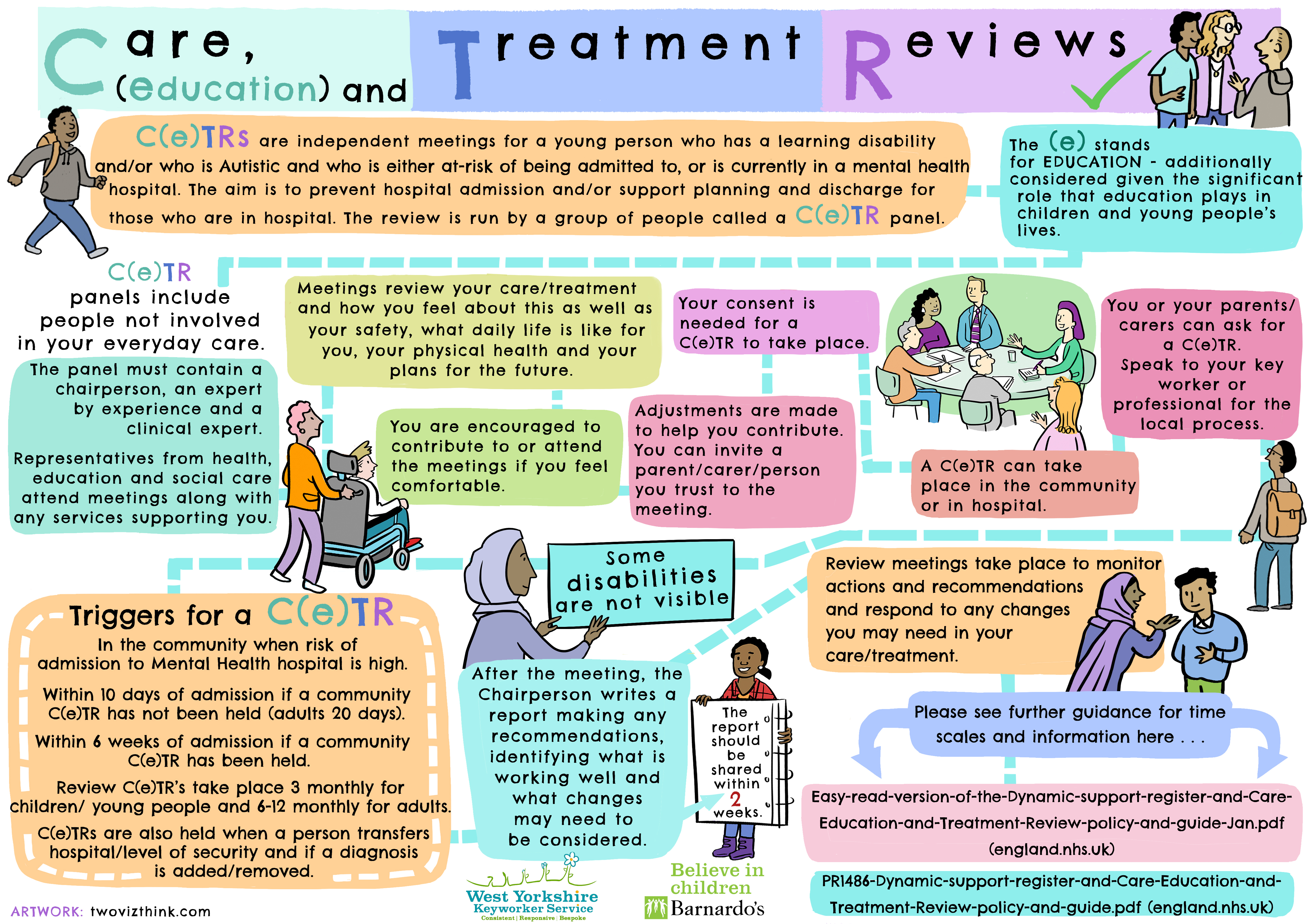
C(E)TRs were introduced in 2015. They are helping to reduce the number of people being admitted into hospitals. C(E)TRs also seek to improve the quality of care people receive in hospital by asking key questions and making recommendations that lead to improvements in safety, care and treatment. They aim to reduce the amount of time people spend in hospital and bring people together to help to sort out any problems which can keep people in hospital longer than necessary. They do this by helping to improve current and future care planning, including plans for leaving hospital.
C(E)TRs are carried out by a panel of people, which includes an expert by experience, clinical expert and a chair. The expert by experience is an autistic person or a person with a learning disability or a family carer with lived experience of services. The clinical expert is an appropriately qualified healthcare professional who offers their independent clinical opinion about patient care, education and treatment. The panel will be chaired by a suitably trained person who is responsible for leading the review panel and ensuring the process remains person-centred.
The policy for C(E)TRs was last updated in January 2023 and now includes the Dynamic Support Register (DSR) to ensure people work together to review the needs of each person on the register. The DSR enables systems to identify adults, children and young people with increasing and/or complex health and care needs who may require extra support, care and treatment in the community as a safe and effective alternative to admission to a mental health hospital.
Supporting materials, including the C(E)TR code and toolkit and the key lines of enquiry template have been refreshed in accordance with the new policy and can be accessed here.